
Search Alabama Criminal History
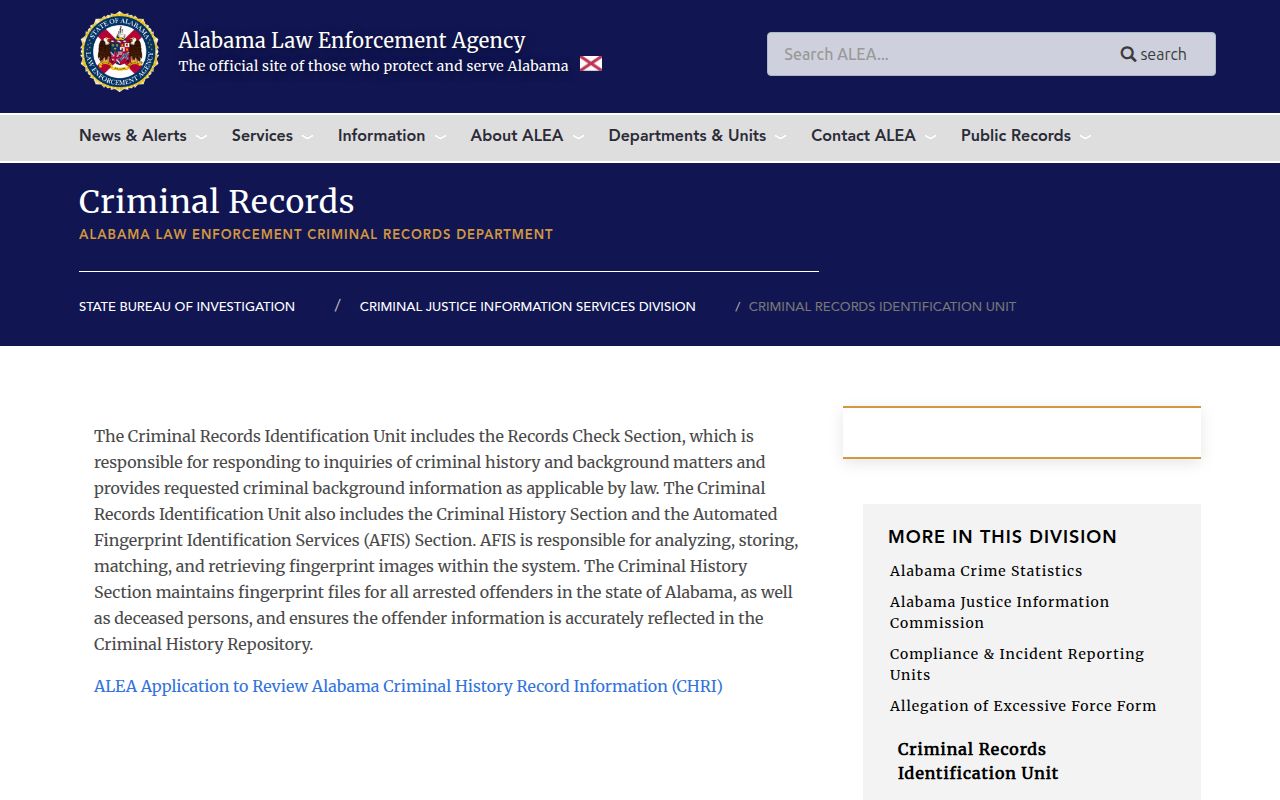
Alabama criminal history records are kept by the Alabama Law Enforcement Agency (ALEA) as the main state repository. All 67 counties send arrest records to ACJIC. Circuit Court Clerks in each county keep criminal case files, with felony and misdemeanor filings, judgments, and sentencing orders. Alacourt ACCESS gives statewide online court record search. Criminal history data is marked as public record under Alabama Code § 36-12-40, subject to some legal exemptions for juvenile records and sealed cases.
Alabama Criminal Records Quick Facts
Primary Sources for Alabama Criminal History Records
Alabama Law Enforcement Agency (ALEA)
ALEA's Criminal Records Unit is Alabama's official repository. ALEA maintains fingerprint files for every arrested offender in the state and manages the Alabama Criminal Justice Information Center (ACJIC). Fingerprint checks are the most reliable method. The ACJIC processes over 15 million transactions monthly and connects Alabama to the FBI's National Crime Information Center.
| Phone | 1-866-740-4762 or 334-676-7897 |
|---|---|
| Hours | 8:00 AM - 5:00 PM CST, Monday-Friday |
| Physical Address | 301 South Ripley Street, Montgomery, AL 36104 |
| Mailing Address | P.O. Box 1511, Montgomery, AL 36102-1511 |
| Website | www.alea.gov |
How to Request Your Criminal History from ALEA
- Obtain fingerprints at authorized law enforcement agency or Fieldprint location
- Complete ALEA Application to Review Alabama CHRI (Form 46)
- Submit application with fingerprint card, $25 money order or cashier's check, and copy of valid photo ID
- Mail to address above or deliver in person
- Receive results in 3-5 days for electronic fingerprints or 4-6 weeks for ink cards
The ALEA background check provides the most complete criminal history available in Alabama, including all arrests, charges, court dispositions, convictions, sentences, and incarceration records submitted to the state repository. Pursuant to Alabama Code § 41-9-644, ALEA may impose fees not to exceed $25 for criminal offender records inspections.
Alacourt ACCESS - Statewide Court Records
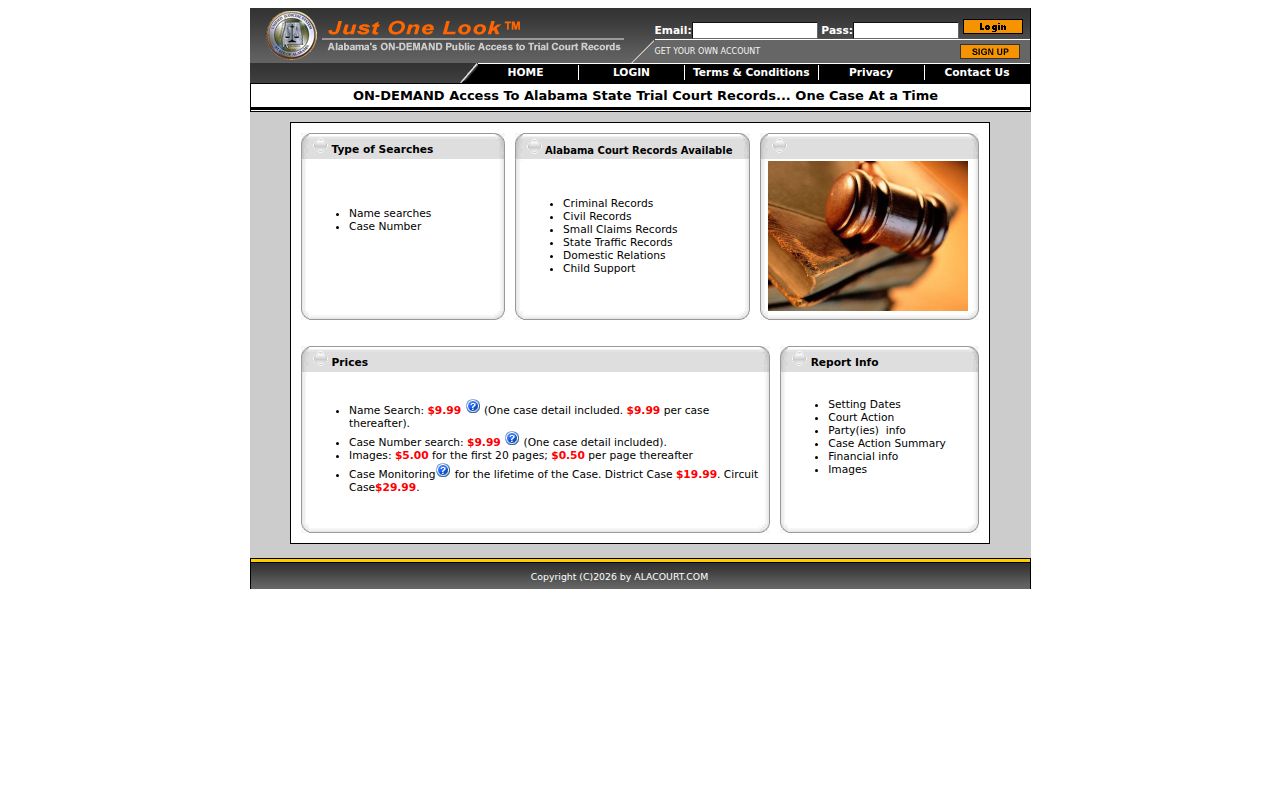
The Alabama Administrative Office of Courts operates Alacourt ACCESS V2.0, which provides public access to all state trial court records across Alabama's 67 counties. The system contains criminal, civil, domestic relations, and traffic case information from circuit courts and district courts statewide. Name searches and case number searches are available immediately online.
| Website | pa.alacourt.com |
|---|---|
| Coverage | All circuit and district courts in Alabama |
| Search Types | Name search or case number search |
| Information Available | Case numbers, filing dates, charges, dispositions, sentencing, fines |
| Limitations | Does not include juvenile records, sealed records, or expunged cases |
The Alacourt system displays docket entries and case status information but does not provide full court documents. For detailed records such as indictments, plea agreements, or sentencing orders, interested parties must contact the Circuit Court Clerk in the county where the case was filed. Court clerks can provide certified copies of documents for applicable copying fees.
Circuit Court Clerks - County Level
Each of Alabama's 67 counties has an elected Circuit Court Clerk who serves as the official custodian of criminal court records. Circuit Clerks maintain case files, process public records requests, issue warrants and subpoenas, and serve as magistrates for law enforcement. Felony cases are filed at the circuit court level, while misdemeanors are handled by district courts.
Criminal case files maintained by Circuit Clerks include indictments, arrest warrants, booking information, arraignment records, pre-trial motions, plea agreements, trial transcripts, verdicts, judgments, sentencing orders, probation terms, and appeals documentation. The clerk's office provides in-person access to court files during business hours. Copying fees typically range from $0.50 to $1.00 per page, with certification fees of $1.00 to $5.00 per document.
Records requests may be submitted in person, by mail, or in some counties through online portals. Each county operates independently with varying procedures and processing times. Larger urban counties like Jefferson and Mobile generally offer more extensive online resources and may process requests within 1 to 3 business days. Smaller rural counties may require in-person visits or written requests and can take one to two weeks for fulfillment. Some clerk offices accept requests via fax or email, but policies differ widely. It helps to call ahead and confirm what methods the specific county accepts and what fees apply before submitting your request.
Fees and Costs
State-Level Fees
| Service | Cost |
|---|---|
| ALEA Background Check (first copy) | $25 (money order or cashier's check only) |
| ALEA Background Check (additional copies) | $5 each |
| Alacourt ACCESS per search | $9.99 (credit/debit card online) |
| Fingerprinting (law enforcement agencies) | $15-$25 |
| Fingerprinting (private services) | $30-$50 |
| Fieldprint Alabama (DHR checks) | $47.20 |
County-Level Fees
Circuit Court Clerks set fees according to county schedules. Typical costs include record copying at $0.50 to $1.00 per page, certified copies with additional $1.00 to $5.00 certification fees, and transcript copies at $2 to $4 per page. Some counties charge search fees while others provide free in-person record viewing. Sheriff's offices may charge $5 to $15 for arrest report copies. Fees vary significantly by county.
Free Resources
Several resources are available at no cost. The Alabama Department of Corrections inmate search lets you look up state prison inmates for free. ALEA operates the sex offender registry with no fee for searches. County sheriff websites often list current jail rosters at no charge, though not all 67 counties provide this online. The Alabama Appellate Courts Public Portal gives free access to appeals court records and opinions. You can also inspect public court records in person at any courthouse during regular business hours without paying a viewing fee. Some clerk offices only charge when you request copies or certified documents.
Secondary Sources - Related Records
Alabama Department of Corrections
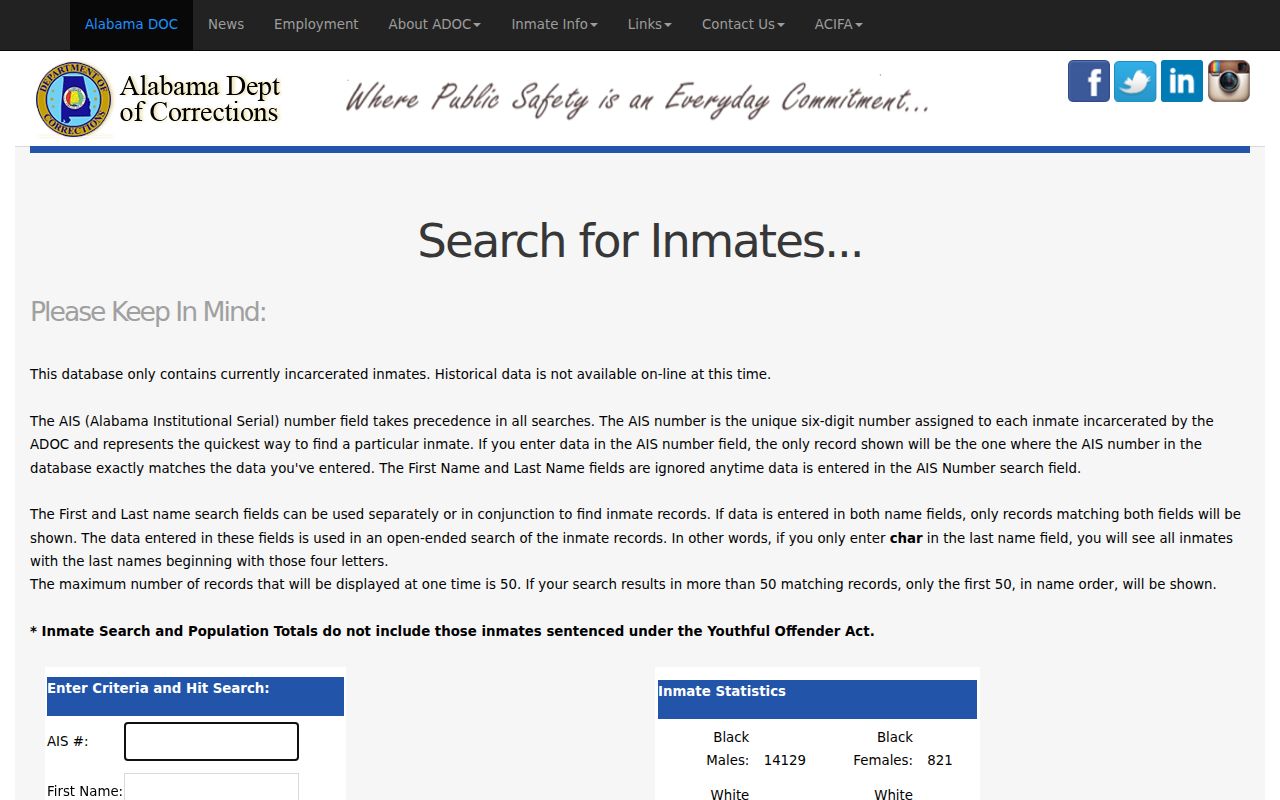
The Alabama Department of Corrections maintains an online inmate search database at doc.alabama.gov/inmatesearch.aspx. The database contains current and historical incarceration records for all state prison inmates. Search options include AIS number (Alabama Institutional Serial number) or inmate first and last name. Information provided includes current facility location, admission date, projected release date, offense information, county of conviction, and sentence length. The database updates daily but may have a 24 to 48 hour lag for new bookings or releases. County jail inmates are not included in the state DOC database.
Alabama Sex Offender Registry
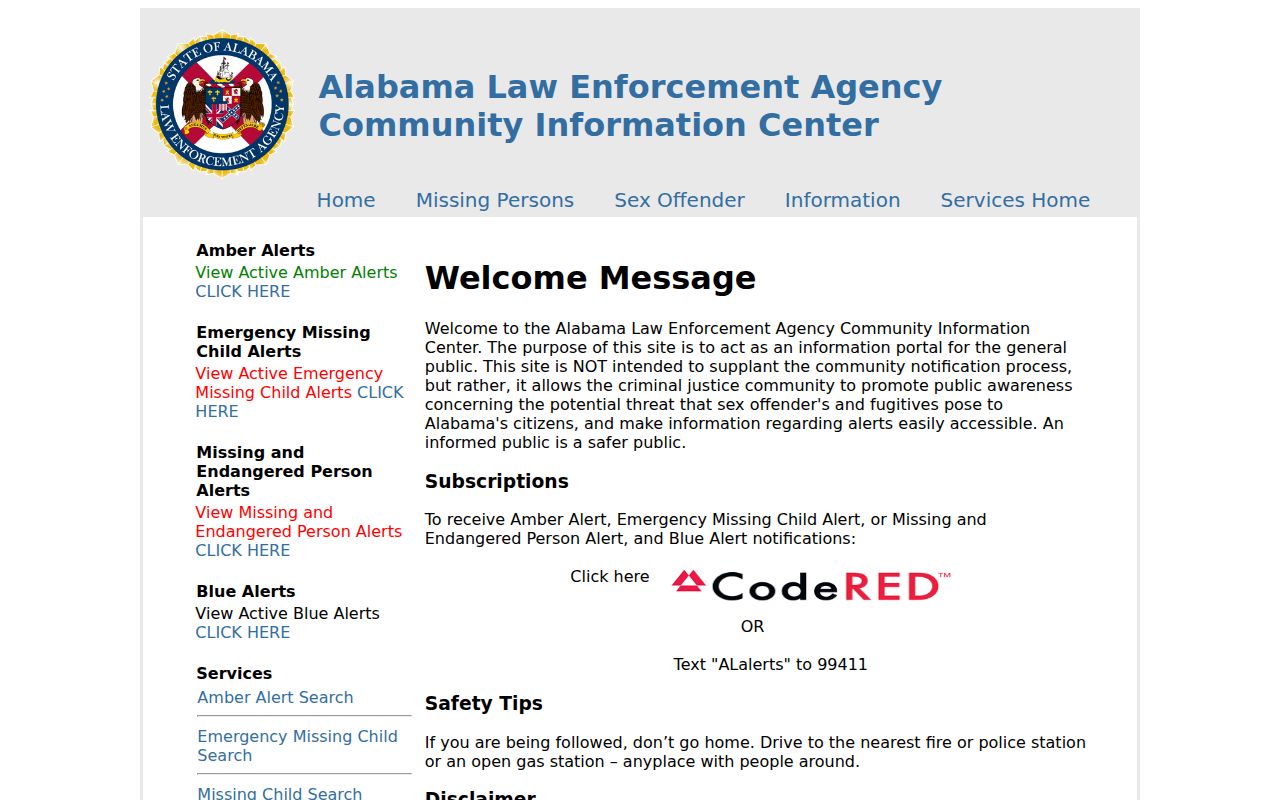
The Alabama Law Enforcement Agency operates the official sex offender registry through the Community Information Center portal. The registry contains over 16,000 registered sex offenders and updates in real time daily. Search capabilities include name search, address search, geographic radius search, zip code search, and county search. Information displayed for each offender includes current photograph, physical description, current address, employer information, vehicle information, conviction details, risk level classification, and registration status. Pursuant to the Alabama Sex Offender Registration and Community Notification Act codified at Alabama Code § 15-20A-5, law enforcement agencies must notify communities when offenders move or change addresses.
County Sheriff Arrest Records and Jail Rosters
County sheriffs maintain arrest records, booking information, and current jail rosters. Alabama Code § 36-22-8 requires each sheriff to maintain a book listing every inmate in the county jail, accessible for public inspection during business hours. Many counties provide online inmate searches and 24-hour arrest lists. Larger counties such as Jefferson, Mobile, Baldwin, Madison, and Shelby have comprehensive online systems. Rural counties may require in-person visits or phone inquiries. Arrest records are public under the Alabama Open Records Act.
Alabama Appellate Courts
The Alabama Appellate Courts Public Portal at publicportal.alappeals.gov provides free access to Alabama Supreme Court, Court of Civil Appeals, and Court of Criminal Appeals records. The portal contains case dockets, briefs and motions, court opinions, oral argument information, and case status updates. Criminal appeals typically involve challenges to convictions or sentences from circuit court trials. The portal allows searching by case number, party name, attorney name, judge name, or date range.
Municipal Courts
Cities with municipal courts handle misdemeanor offenses, traffic violations, and municipal ordinance violations within city limits. Municipal courts have jurisdiction over cases with maximum penalties of one year in jail and fines typically not exceeding $500. Major cities including Birmingham, Mobile, Montgomery, Huntsville, and Tuscaloosa operate municipal courts. These courts maintain separate records from circuit and district courts. Municipal court records may be available through city government offices or the Alacourt system in some jurisdictions.
Deep Research - Additional Sources
Alabama Background Check (ABC) System
The Alabama Background Check system is a secure web-based portal providing name-based criminal history searches for qualifying employers and authorized agencies. Access is restricted to organizations with established right to know. The system provides real-time access to state criminal records updated daily from the ACJIC repository. Employers must register with ALEA and maintain subscription access. Contact ALEA at 1-866-740-4762 or 334-676-7897 for ABC system registration. Name-based searches are not guaranteed accurate without fingerprint verification.
Federal Court Records - PACER
Federal criminal cases are accessible through the Public Access to Court Electronic Records (PACER) system at pacer.uscourts.gov. Alabama has three federal districts: Northern District (Birmingham and Huntsville divisions), Middle District (Montgomery division), and Southern District (Mobile division). PACER provides federal criminal case searches, indictments, plea agreements, sentencing records, and appeals. Users must register at the PACER Service Center. Fees are $0.10 per page capped at $3.00 per document.
Alabama Bureau of Pardons and Paroles
The Alabama Bureau of Pardons and Paroles at paroles.alabama.gov handles pardon applications, restoration of civil rights, and certificates of eligibility to register to vote (CERV). The bureau maintains records of probation and parole supervision, case load information, and compliance monitoring. Public information is available by contacting 334-242-8700 (option 3) or pardons@paroles.alabama.gov. Pardon records become part of an individual's criminal history file.
Alabama Crime Statistics
The Alabama Crime Statistics portal at crime.alabama.gov provides statewide crime data and trends maintained by ALEA. The portal contains county-level statistics, incident reporting data, annual crime reports, and Uniform Crime Reporting (UCR) data. While this source does not provide individual criminal history records, it offers context for crime patterns and law enforcement activity across Alabama.
District Attorney Offices
Alabama has 42 judicial circuits, each served by an elected District Attorney. District Attorneys prosecute all felony crimes and many misdemeanor offenses within their circuits. District Attorney offices maintain prosecution case files, charging decisions, plea agreements, trial preparation documents, and victim impact statements. Most records are incorporated into court files accessible through Alacourt or Circuit Court Clerks. Some District Attorney offices maintain public websites with case information and resources.
Legal Framework and Statutes
Public Access to Records
Under Alabama Code § 36-12-40, every citizen has a right to inspect and take a copy of any public writing of the state, except as otherwise expressly provided by statute. This foundational public records law establishes the legal basis for access to criminal history records that are not protected by privacy statutes. The statute includes exemptions for library records, critical infrastructure information, and materials where disclosure could threaten public safety.
Criminal Justice Information Center
Alabama Code § 41-9-620 establishes the statutory authority for the Alabama Criminal Justice Information Center (ACJIC) and Commission. This section authorizes ACJIC to provide for a uniform crime reporting system and serves as the foundation for administrative rules governing criminal history record information. Section 41-9-621 provides statutory authority for criminal justice information reporting requirements administered by the Alabama Justice Information Commission.
Under Alabama Code § 41-9-644, agencies including ACJIC may impose fees not to exceed $25 for criminal offender records inspections. Agencies may also prescribe reasonable hours and places of inspection, impose additional procedures, and require fingerprinting. This statute sets the maximum fee structure for accessing criminal history records in Alabama.
Expungement Procedures
Alabama Code § 15-27-1 allows persons charged with misdemeanors, violations, traffic violations, or municipal ordinance violations to petition for expungement in several circumstances, including when charges are dismissed with prejudice, no-billed by a grand jury, or the person is found not guilty. The statute requires more than 90 days to have passed since disposition. Persons convicted of misdemeanors may petition if all probation requirements are completed and three years have passed from the date of conviction.
Alabama Code § 15-27-2 allows persons charged with felonies to petition for expungement when charges are dismissed with prejudice, no-billed by a grand jury, or the person is found not guilty, with more than 90 days having passed. For dismissed cases without prejudice, five years must pass with no other convictions during that period. Circuit court has exclusive jurisdiction over felony expungement petitions.
Alabama Code § 15-27-13 requires the Administrative Office of Courts to provide an annual report to the Legislature specifying the number of applicants requesting expungement and the number of expungement petitions granted. This reporting requirement provides transparency and allows monitoring of Alabama's expungement laws.
Juvenile Records Confidentiality
Alabama Code § 12-15-133 establishes strict confidentiality protections for juvenile court records. Records, reports, and information acquired or generated in juvenile courts concerning children are confidential and cannot be released except as provided in the statute. Unauthorized disclosure or use of information identifying a child under juvenile court jurisdiction is a Class A misdemeanor and may subject the offender to civil sanctions. This statute shields juvenile criminal history from public access.
Alabama Code § 12-15-134 requires reporting of certain acts of juvenile delinquency to the Alabama Criminal Justice Information Center. While juvenile records are confidential, this section establishes that certain juvenile offense information must be reported to ACJIC for inclusion in the state criminal history repository, subject to confidentiality protections.
Administrative Regulations
The Alabama Administrative Code Title 265 governs the Alabama Criminal Justice Information Center. Chapter 265-X-2 specifically addresses Security and Confidentiality of Criminal Justice Information. Key provisions include requirements for privacy and security agreements, access controls for criminal justice agencies and non-criminal justice agencies, and individual rights to access, review, and challenge their own criminal history record information. These regulations are accessible at admincode.legislature.state.al.us.
Arrest and Fingerprinting
Alabama Code § 15-10-90 requires sheriffs to fingerprint persons taken into custody and furnish copies of fingerprints to the FBI Director and ALEA. This statute establishes the mandatory fingerprinting procedures that create the biometric component of criminal history records. Fingerprints serve as the primary identifier linking arrest records, court records, and corrections records to specific individuals.
Alabama Code § 41-9-625 requires criminal justice agencies to obtain fingerprints, full face and profile photographs, and other identifying data of persons arrested for designated offenses. When a defendant is released without charge or cleared of an offense, the agency must expunge identification information including booking photographs.
Browse by Location
Search by County
Criminal court records in Alabama are maintained at the county level by Circuit Court Clerks. Each of Alabama's 67 counties operates an independent clerk's office with responsibility for criminal case files, dispositions, and public records access. The clerk serves as the official custodian for all circuit court documents. This means felony cases filed in Jefferson County stay with the Jefferson County Circuit Clerk, not with a state office. If you need records from multiple counties, you have to contact each clerk separately. Some larger counties now use digital systems that let you search online, but many still keep paper files that require an in-person visit or mail request.
View All 67 Alabama Counties →
Search by City
Criminal history records for city residents are filed with the circuit court in the county where the individual resides or where the offense occurred. Municipal courts handle city ordinance violations separately from criminal history records.
Start Your Search
Search criminal history records through Alabama's official databases: